GI Broker Network Health Score Sample
What the data shows
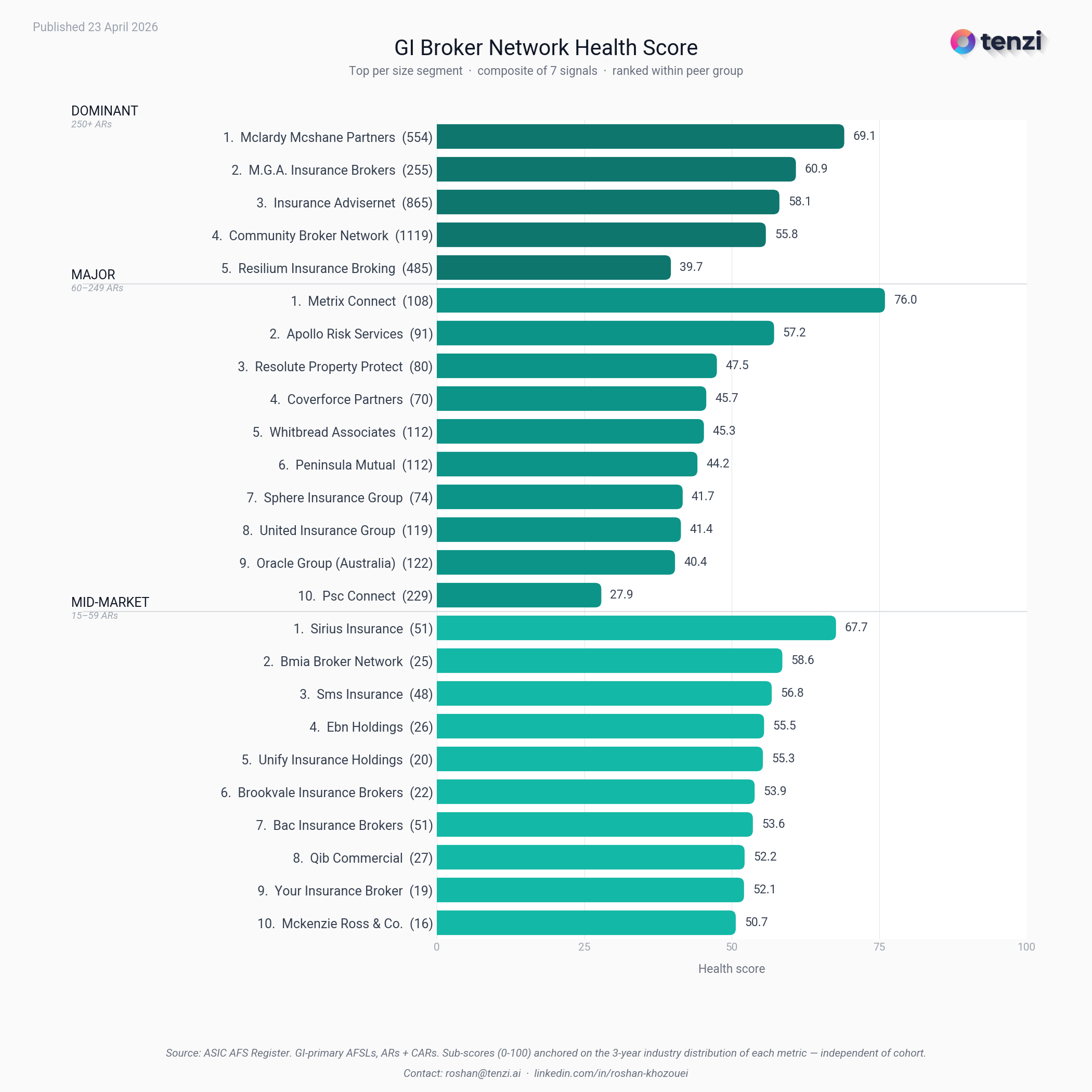
5 FINDINGS- Metrix Connect (108 ARs, score 76.0) tops the entire leaderboard — a Major-segment network outscoring every Dominant in the country. Size isn't health.
- McLardy McShane (554 ARs, score 69.1) is the top-scoring Dominant — and they earned it. 27% of their 12-month joiners arrived with 5+ years of industry experience, placing them near the top decile of the industry distribution for experienced intake. They're attracting seniors, not recycling junior talent.
- Sirius Insurance (51 ARs, score 67.7) beats every Dominant except McLardy. A Mid-Market with fifty brokers outranks four of the five 250+ networks. A +155% 12-month headcount change and a 32-to-1 joiner/leaver ratio drive the score.
- Community Broker Network (1,119 ARs, score 55.8) — Australia's largest GI-primary network — ranks 4th in its own segment. On this chart, several smaller networks outscore them. Weakest signals: tenure advantage (37.3) and speed of growth (51.4). Scale alone isn't carrying them.
- Size isn't health. Growth alone isn't health. The composite combines seven signals — size, net growth, speed of growth, flow balance, tenure advantage, experienced intake, and stability. What matters is the quality of the people you're attracting and the quality of the people you're keeping.
The seven signals
COMPOSITE- Size — AR headcount on a log scale. Bigger networks are more resilient, with diminishing returns.
- Net growth — 12-month headcount change as a share of the starting AR count.
- Speed of growth — rolling 6-month rate of change. Captures momentum independent of one-off events.
- Flow balance — joiners-to-leavers ratio on a symmetric log scale. High = attracting more than you're losing.
- Tenure advantage — median industry tenure of 12-month joiners minus median industry tenure of 12-month leavers. Positive means trading up on experience.
- Experienced intake — share of 12-month joiners with 5+ years of industry tenure. Measures whether growth is senior-led or training-mill.
- Stability — inverse churn rate. A network that can't retain brokers is leaking its most valuable asset.
Source: ASIC Financial Advisers Register, snapshot April 2026. Scoring pool is GI-primary AFSLs with ≥15 ARs. Thresholds are calibrated against 36 months of industry data — the same raw metrics always yield the same score regardless of cohort. Sub-scores are shrunk toward the neutral midpoint (50) in proportion to sample size, so flow-based metrics don't peg to 100 purely from absence-of-events at small networks. Size segments (Dominant 250+, Major 60–249, Mid-Market 15–59) are a presentation choice — scoring is segment-independent. Industry-level caveat: the tenure-advantage distribution is almost entirely negative across the industry, so a high tenure-advantage score means "less negative than most," not "hiring seniors."
Want the full leaderboard?
Global top-20 rankings, per-signal heatmaps, individual AFSL scorecards with sub-score breakdowns, and custom calibration windows. Refreshed monthly alongside the ASIC register.